

Press release · Q1
Fresh satellite data reveals spectacular space discoveries
New data from a satellite one million miles from Earth has helped UK scientists shed light on how mysterious forces shaped the evolution of the Universe.
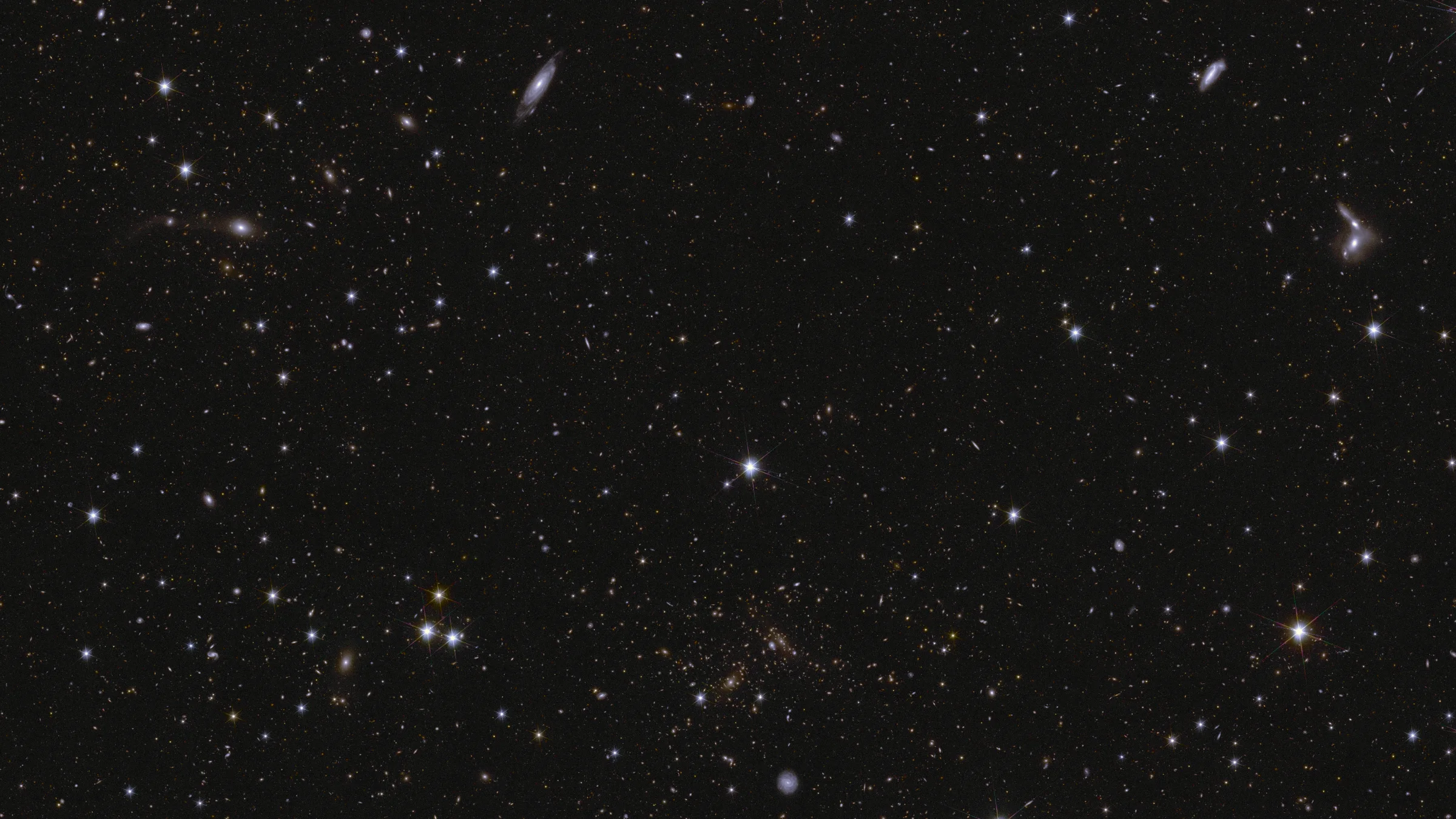
The release of the first survey data from the European Space Agency’s pioneering Euclid satellite – made public today – has led to a flurry of scientific advances that further our understanding of the cosmos.
Launched in July 2023, Euclid is mapping the Universe with unprecedented precision and accuracy. By examining more than one billion galaxies over six years, this groundbreaking space telescope aims to explore two of astronomy’s biggest mysteries: dark matter and dark energy.
Despite covering less than 0.5 per cent of the complete study area, the data is already proving to be a treasure trove for UK scientists.
Researchers from the University of Edinburgh lead the UK’s involvement in the data analysis and host the UK’s Science Data Centre for Euclid.
As a key part of the Euclid Consortium, Edinburgh processes the huge amounts of data from the satellite before it is studied by teams in the UK and across the wider Euclid Consortium. This process is already having exciting ramifications for astronomy.
A team based at the Universities of Oxford and Portsmouth combined the power of citizen scientists and machine learning algorithms to sift through the more than one million galaxies seen in Euclid’s latest data, searching for strong gravitational lenses.
These phenomena occur when massive objects, such as galaxies, distort space-time so much that they warp the light from objects behind them into rings or arcs.
Such lenses are incredibly rare – researchers liken it to searching for needles in a haystack - but the team has identified 500 strong lens candidates.
Rarer still are systems which contain two galaxies being lensed by the same object. Four of these have been spotted and will help astronomers understand the shape and structure of the Universe.
“These lenses are already allowing us to learn about our Universe, but this is just the beginning for Euclid. The full Euclid survey will be a revolution for strong lensing”.
Astronomers at Lancaster University have used Euclid data to enhance their study of transients, objects whose brightness change over a relatively short time.
Euclid’s immense power has helped researchers observe supernovae, the sudden bright explosions that occur when some stars die, long after they have disappeared from the view of observatories on Earth.
“It is amazing to use Euclid to be able to see transients and their host galaxies in such spectacular detail, especially well before and after we would otherwise be able to see them from observatories searching for supernova here on Earth. This will allow us to increase our understanding of supernova and where they came from.”
Researchers at the University of Bristol, led by PhD student Teresa Matamoro-Zatarain, have found a number of supermassive black holes gradually accumulating in the centres of galaxies.
Also known as Active Galactic Nuclei (AGN), they make up less than 10 per cent of the galaxy population in the Universe.
Combining Euclid data with other light wavelength survey is enabling a new era of AGN exploration, experts say. A Euclid-AGN group has created the first catalog of these black hole groupings.
“The combination of sensitivity and spatial resolution of Euclid truly creates a new era of big-data exploration”
In addition to leading some of the first scientific papers to come from this data, the UK has played a key role in the development of Euclid since its inception. University College London’s Mullard Space Science Laboratory (MSSL) led the production of Euclid’s visible instrument (VIS), a powerful camera used to capture visible light from distant galaxies.
Elsewhere, a partnership of seven UK universities contributed strongly to the Science Ground Segment, which receives the initial data from the Euclid satellite and transforms it into data that scientists can work with instantly.
A much larger data release is scheduled for October 2026 which will include results about the nature of dark energy.